1.DEFLECTOR (Magician)
The Magician Reversed — Mercury
(scroll past lyrics to read about the song)

“I’m fine. How are you?” —
The question that frees me.
“I’m fine” is a door I close before they can look.
[INTRO]
The wall held me up
so I didn’t have to hold myself.
Became part of the scenery,
to let others be seen.
My little self knocks.
I pretend I’m not home.
Deflection is the art of turning away.
Deflector is me.
[CHORUS]
When the talk gets close —
the topic turns,
I name the weather,
I deflect it.
“Look over there.”
Sidestep, redirect.
Deflector,
I divert.
I’m not what they’re looking for.
I keep the magic, I close the door.
(Deflector.)
[VERSE 1]
I am the trickster who tricks herself.
I know the magic.
But I won’t cast the spell.
Attention means criticism.
I learned certain topics are forbidden.
Tongue spins illusions —
polish on the surface,
panic in the eyes.
Hands jitter, jaw shivers —
stomach quivers.
I learned to point away
before they could point at me.
Trickster mind, mouth alchemy.
I hide in plain sight.
Intimacy intrudes, pries the wound —
The wand stays still.
My hips stay locked.
Every twitch betrays the silence,
blurting truth.
I bend reality with words,
it bends me back.
Crow says:
“You’ve been practicing sleight of hand
on yourself for years.
These cards are yours —
you keep handing them back.
Play them.”
[PRE‑CHORUS]
Wallflower at the edge, wand at my side.
Ghost gives away our light.
I hold the door, but they walk through —
My magic waits inside.
[CHORUS]
When the talk gets close —
the topic turns,
I name the weather,
I deflect it.
“Look over there.”
Sidestep, redirect.
Deflector,
I divert.
I’m not what they’re looking for.
I keep the magic, I close the door.
(Deflector.)
[VERSE 2]
Truth arrives. I change the subject.
Illusion blurs the seeing.
[pause]
“I’m fine. How are you?” —
The question that frees me.
“I’m fine” is a door I close
before they can look.
I dwell in the space
just before being seen.
Forget what I wanted to say.
Deflector says:
“I’m nothing special anyway.”
She says I’m an imposter —
that’s the voice I master.
I study them so I don’t have to study me.
Sleep won’t claim me; the night denies.
And still, I fear to drop the disguise.
Deflection’s a spell that leaves me last.
Ghost whispers:
“You’ll shatter if they see you whole.”
Crow replies: “Then give ’em a show!”
[PRE‑CHORUS]
[CHORUS]
[BRIDGE]
I’m learning to stay
in the center of my own life.
I step from the wall.
It never needed me at all.
I was the one who held on.
I pick up the wand.
My hand trembles —
Desire moves through me.
[POST‑CHORUS]
I don’t change the subject anymore.
I hold the magic —
Open the door.
I choose to be seen.
I am what I’m looking for.
[OUTRO]
Crow asks: “Are you ready to be seen?”
I say: “I’m learning.”
Crow leans closer:
“You don’t have to perform the answer.
You are the question.”
Speak from the ground.
The ones who need to hear you
will know your sound.
The ghost dies when I evolve.
Her tricks turn dust,
illusions dissolve.
(Rest in peace, ghost)
(East, East, East)
Card & Ghost
Tarot Card:The Magician (Reversed)
Thoth Name:The Magician (Unchanged)
My Ghost: Deflector
Zodiac: — (Mercury) · Planet:Mercury
Mercury energy communicates. The Magician directs will — but Deflector points elsewhere.
Hebrew Letter: Beth (ב)
Path:12
What It Means Reversed:
All the tools are in my hands, but I keep handing them away. I know how to work the room—I don’t know how to work myself.
About the Song
I spent years perfecting the art of being overlooked. In a family of louder voices, I learned to stand in corners, to let the spotlight pass. Let others be the smart ones, the funny ones, the talented ones. I was the one who read the room before it needed reading, who made sure everyone else felt comfortable before I ever asked what I felt.
I called myself a wallflower. I always thought it sounded cute and poetic. It was survival.
The corner fit me like a second skin. Safe. Invisible. Reliable. I became the one who holds the door, who smooths the edges, who knows exactly when to step sideways so the conversation can keep flowing. I learned the dance before I had words for it — the sidestep, the redirect, the smile that says "nothing to see here."
Around me, serious topics were handled with a quick turn to something safer. A heavy sentence lands, and suddenly someone was asking about the weather, or mentioning dinner, or turning toward the child in the room. The hard thing sat there, untouched, while we all pretended it hadn't arrived.
My body learned it first. My shoulders turn before the question finishes. My breath stays shallow, as if taking up less space keeps me safer. When the spotlight lands — when someone really looks — my hands feel restless, ready to reach for something, ready to pull back. I answer questions with questions. I make myself the mirror instead of the source.
Now the room has changed. People are looking. The engagement is real. And my first instinct is still to point elsewhere. I catch myself doing it — answering before I think, redirecting before I land, making sure they're comfortable before I let myself be seen.
"Ghost says I'm nothing special anyway."
This song is the moment I catch myself mid‑sidestep. The moment I remember I'm holding a wand.
I'm learning that the corner was never the only place. The wall doesn't need me to hold it. The tools were never meant to be handed away.
Deflector kept me safe when safety meant not being seen. Now safety means letting the light land. I'm still learning. But I'm not handing the wand back anymore.
What This Ghost Is
Deflector is the part of me that learned to point before anyone could point back. She's the reflex that answers a question with a question, that turns the spotlight into a mirror and hands it to someone else.
She has the tools — every tool. The wand of will, the cup of feeling, the dagger of thought, the disk of form. She knows how to work a room, how to read a silence, how to make people comfortable. What she doesn't know is how to use any of it for herself.
This ghost was born in the corner. I spent years there, watching others take the light, learning that being seen meant being judged. The corner fit me like a second skin — safe, invisible, reliable.
But Deflector isn't just the wallflower. She's the active one, the one who steps sideways before the question lands, who wears "I'm fine" like a coat she can't take off in public. She's the voice that says "look over there" when the gaze gets too close, the hand that waves away concern before it can arrive.
She learned from a childhood of deflection. Serious topics arrived and were met with a sudden interest in the weather, a quick turn of attention to the child in the room. A hug ended with a mention of food. The heavy thing sat there, unheld. I learned the dance before I had words for it.
I call her Deflector.
A costume made from breath‑holding. A decision loop dressed in praise. She is excess memory — the accumulated habit of making myself small so others could be large.
The tools are in my hands. I keep handing them back. I know the magic. I won't cast the spell.
She taught me to be the mirror, not the source. The wall that holds the room, never the center. The one who knows your rhythm so she can step aside before you see her.
Deflector kept me safe when safety meant not being seen. Now safety means letting the light land.
The Wand and the Body
The Magician's wand is a phallic symbol. Crowley was explicit about this. The wand is the will made flesh, the tool of creation, the point of directed energy. When the Magician is upright, the wand points outward — desire flows, creation happens, the will manifests. When reversed, the wand is hidden, turned away, or used to point elsewhere. The will is blocked. The energy that should flow gets stuck or misdirected.
So Deflector isn't just about conversation. She's about desire.
I learned to use my sexuality as deflection. Before I had my son, I was hypersexual — not from abundance, but from fear. I expected sex every day. Not because I wanted it, but because I was terrified of what might happen if I didn't. If I kept them satisfied, they wouldn't cheat. If I performed enough, they wouldn't look elsewhere. My desire became a management tool. The wand pointed at them, never at myself. I used sex like a seatbelt — if I gave enough, they wouldn't leave.
That's Deflector. That's the wand pointed outward to serve others, to manage their behavior, to keep myself safe through performance. I wasn't expressing my own wanting. I was using my body as a tool of vigilance.
Then I had my son. Something shifted. The hypersexuality didn't just calm down — it froze. I went from one extreme to the other. From performing desire every day to feeling almost nothing. Rigid. Cold. Afraid. The wand that once pointed frantically outward now hid entirely. I didn't know how to want for myself anymore.
I've also been on the other side of this — partners whose bodies wouldn't cooperate, whose will was split, whose fear of failure or judgment blocked the very energy they wanted to express. Erectile dysfunction, performance anxiety, arousal that comes and goes. That's the Magician reversed in another body: the wand is there, the desire is real, but the ghost says "don't be seen," "what if you're not enough," "perform correctly or else." The body listens. The body obeys the ghost.
This isn't about morality. It's about will. Can I want without performing? Can I receive without deflecting? Can I let the wand point where I actually want it to go — not where I think it will keep me safe?
I'm still learning. The rigidity hasn't fully thawed. But naming it — calling it Deflector — is the first step. The wand is mine. I'm learning to point it inward.
The Wand Turns Inward
Here's what I didn't see coming.
When I stopped using sex as a seatbelt — when I stopped performing desire to keep someone close — the wand didn't go dead. It redirected.
I started journaling. Morning pages, mostly. Pen in hand, words on paper, no audience, no performance. Just me and the page. And I realized: the pen is a wand too. It points. It creates. It directs energy outward — but this time, the energy is mine. Not a transaction. Not a management tool. Just... expression.
I became prolific. Loui Crow was born in that shift. The hypersexual vigilance calmed down, and in its place came songs, blogs, rituals, a whole funeral for false selves. I didn't lose my desire — I translated it. The wand that once pointed frantically at others now points at the page, the mic, the mirror.
I have a safe marriage now. A husband who stays. A home that doesn't leak. And in that safety, I finally have room to unpack — not to perform, not to deflect, just to be. To write. To create. To let the wand point where it actually wants to go.
I'm still a toddler at this. Reparenting my inner child, learning to want without shame, learning to create without performing. Some days I still deflect. Some days the old habits whisper "look over there." But the pen stays in my hand. The wand is mine.
Crow says: "You didn't lose your fire. You just stopped using it to keep others warm. Now it lights your own page."
Where It Lives in the Body
Deflector lives in my pelvis.
The wand of will, the seat of desire — I learned to point it outward, to serve, to perform, to prove. My hips hold the memory of giving to keep. The space between my hip bones feels tight, guarded, as if my own wanting might be dangerous.
She lives in my sacrum.
The triangular bone at the base of my spine — the sacred bone, the root of creative energy. When I deflect my own desire, my sacrum feels heavy, numb, disconnected. The energy that should flow down through my legs gets stuck at the base. I feel it as a dull ache, a refusal to ground.
She lives in my lower belly.
Not a dramatic pain — just a hollow emptiness. The place where want should live feels like a waiting room. I can sense desire hovering at the edges, but it won't land. It's been trained to ask "what do they want?" before it ever asks "what do I want?"
Tarot & Magick: The Magician Reversed
In the Thoth tarot, The Magician is Mercury — the messenger, the trickster, the one who bridges worlds. Upright, he directs will outward. He uses the wand, the cup, the dagger, the disk with intention. He is the source.
Reversed, the tools use him. His energy scatters. He performs instead of being. He knows the words — and uses them to deflect, not to reveal.
Deflector is Mercury's shadow: the trickster who tricks herself. The one who could shine, but keeps pointing elsewhere.
Correspondences (from my study notes):
Hebrew letter: Beth (ב) — house, the dwelling of Will
Planet: Mercury — communication, speed, sleight of hand, the messenger God, intellect, skill, and the power to manifest.
Element: Air — thought, word, breath
Magical weapon: The Wand — pointed outward, never inward
Thelemic Thread: Hadit Who Turns Away
In the cosmology of Thelema, Hadit is the point of view — the secret will at the center of every being, the spark that says I am here, I choose this form, I will act. Nuit is the infinite sky — the boundless possibility that gives Hadit room to choose.
The Magician, in the Thoth tradition, is Hadit made visible. The wand points outward. The will directs. The voice speaks.
Reversed, the Magician is Hadit who refuses to point. The wand stays still. The will trembles, then turns away. Not because the spark is gone — but because she's afraid of what happens if she shines. What if her light hurts someone? What if she's seen — really seen — and found wanting?
So she deflects. Changes the subject. Names the weather. She asks "how are you?"
This is Hadit hiding in the corner of the sky, pretending not to be a star. The will is still there — humming, trembling, desperate to point — but she's trained herself to look away. Every deflection is a small death of her own sovereignty.
Crow says: "Nuit stretched herself into infinity so you could have room to choose. She didn't spread herself thin so you could curl up small."
Why This Song Belongs Here
The Hesitator was the first ghost — the spark that agreed to live, then forgot it chose. She froze at the edge of possibility, paralyzed by all the paths.
Deflector is the second ghost — and she is the first ghost of voice and will.
The spark learned words. But instead of speaking, it learned to point elsewhere. Instead of saying "I am here," it learned to say "look over there." Instead of risking the truth of its own tongue, it learned the art of the sidestep, the redirect, the question that answers a question.
This song is where I catch myself mid‑deflection. Mid‑"I'm fine. How are you?" Mid‑"look over there." This is the moment I realize that my voice — and my desire, my will, my wand — has been trained to turn away from myself.
I can't bury the ghosts of silence (Escapist), of over‑care (Smotherer), of control (Commander), of doctrine (Gatekeeper) — until I first admit that I've been hiding in plain sight, using my own tongue and my own body as decoys.
Deflector is the hinge. The funeral can't begin in earnest until I stop pointing away. Until I take the wand — my voice, my will, my desire — and finally point it at myself.
This song is where I stop handing the tools back. Where I stop being the mirror and start being the source.
What This Song Is
It catches the sidestep mid‑step. It asks: What if I held the wand for myself?
It shows the tools in my hands — the wand, the cup, the dagger, the disk — and the moment I finally keep them. It speaks in the language of someone learning to stand in the center of her own life, her own desire, her own will.
It also names the cost of deflection: the loss of my own wanting. The shift from hypersexual to rigid. The body that learned to perform desire but forgot how to feel it.
Crow says: "You've been pointing the wand at everyone else for so long. Try pointing it at the mirror. See what happens."
When Deflector Shows Up
I know Deflector is active when I answer a question with a question. When I say "I'm fine, how are you?" before they can ask again. When I change the subject right when the conversation gets close. When I feel my body shrink under a compliment.
I check for:
Where did I point the spotlight away from myself?
What question did I just answer with another question?
What would I say if I stopped managing the room?
What I've learned from others:
Brené Brown: Brown writes that our ego uses "avoidance" as self-protection, and that "we adopt a pose of indifference or stoicism, or we deflect with humor and cynicism." She taught me that deflection is armor. The tools become shields because being seen feels like being judged.
Pia Mellody: Mellody defines codependency as "a condition wherein one has no inner life. Happiness is on the outside. Good feelings and self-validation lie on the outside. They can never be generated from within." She also describes a "shame attack" as feeling "as though your body is getting smaller. You may blush, want to disappear, run away, or crawl under your chair." That's the somatic truth of Deflector. When the spotlight lands, the body shrinks. The shoulders turn. The breath stays shallow. Mellody taught me that this isn't modesty — it's a boundary failure, the inability to let yourself be seen because being seen feels dangerous.
John Bradshaw: Bradshaw writes: "Toxic shame is a rupture of the authentic self that necessitates developing a false self. With a false self, intimacy is impossible." He also describes the false self as something we create when we "refuse to accept our real selves" and instead "try to create a more powerful false self" to meet other people's expectations. This is Deflector's origin story. She learned early that her true self — her wants, her needs, her voice — wasn't safe to show. So she built a false self that knows how to mirror, to please, to step aside.
Gabor Maté: Maté writes: "Much of what we call personality is not a fixed set of traits, only coping mechanisms a person acquired in childhood." He also teaches that "the attempt to escape from pain is what creates more pain", and that emotional competence requires distinguishing "between psychological reactions that are pertinent to the present situation and those that represent residue from the past." Deflector is a coping mechanism that's outlived its usefulness. Her body learned to deflect before she had words for it. The tight pelvis, the numb sacrum, the hollow lower belly — those are residue. The body remembers the corner even when the room has changed.
Crowley (via Lon Milo DuQuette): DuQuette teaches that the wand is the will, the tool of directed energy. Upright, the magician points outward and creates. Reversed, the will hides. The body follows. I learned to point my desire outward — to serve, to perform, to manage — but never inward. DuQuette gave me the language: deflection isn't just about words. It's about the direction of my own creative fire. The wand stays still because I'm afraid of where it might point.
Questions I ask myself:
Where did I just turn the conversation away from myself?
What would I say if I weren't trying to make them comfortable?
Where am I pointing my wand outward instead of inward?
Am I using my desire to serve them or to know myself?
Blessing
May you stop pointing the wand at everyone else.
May you let your own desire land.
May you learn that your will is not a tool for their comfort.
May you write, create, speak, and want — not to perform, but to be.
A little crow's on the wire, keeping watch over you. 🐦⬛
A Note from My Study
I'm still learning. I don't have this down. I'm still living in the gap, still trying to become more like the music I write. I write for myself — so I can study, so I can hear the direction I want to go.
I'm working from Aleister Crowley's Thoth Tarot, the deck that became my study guide for this album. The correspondences (Hebrew letters, paths, planets) come from that tradition. These notes are just what I've gathered. If they help someone else, that's a gift. If not, they're just breadcrumbs from my own walk.
Deflector taught me that the wand was never meant to point away. Now I'm learning to point it home.
— Thank you for witnessing.
Loui Crow
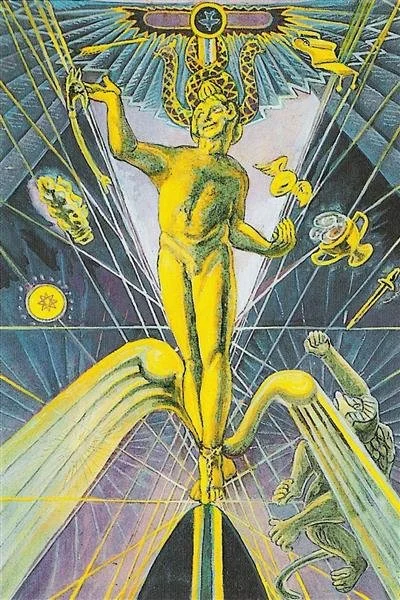
The Magician (Thoth Tarot) — Atu I
In Crowley's Thoth deck, the Magician is the card of will, skill, and manifestation. He holds the four tools — wand, cup, sword, disk — and the serpent eats its own tail, marking eternity. This is the power to focus energy, to speak things into being, to act.
Reversed, that same energy turns inward. The will scatters. The tools become shields instead of bridges. You know the magic, but you don't cast it for yourself.
That's Deflector.
