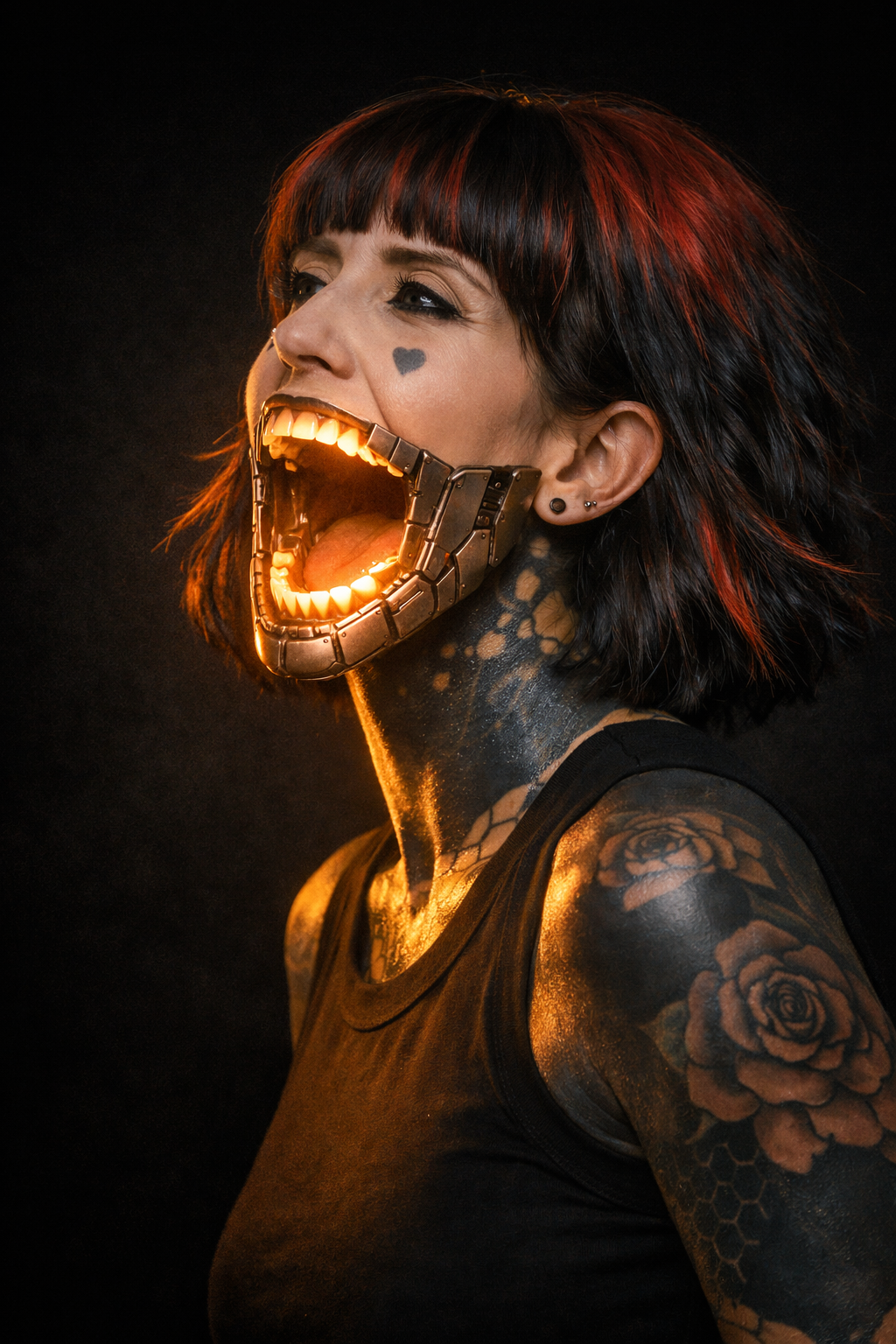
🎤 AI Let My Say It—(The Machine Is My Mouth)
I taught a machine my ache. It sang it back.
My voice moves through code when my own mouth still hesitates.
AI made me impossible to silence anymore.
LYRICS:
I couldn’t finish without help.
I lost too many songs to silence.
So I trained a machine to listen.
AI let me say it. The machine is my mouth.
[VERSE]
AI let me say it — I sever the shame.
Machine is my mouth — I’m naming the name.
I asked for love and it answered true.
But I question if ease can carry the proof.
Like ease means I stole what I didn’t lift.
Like joy can’t bloom unless pain’s in the mix.
Why do I flinch when the lines pour fast?
Like the pain I paid should’ve made it last.
I was seventeen with a folder of songs —
Then the crash came fast and they all were gone.
Every chorus I carved got wiped out.
So I swallowed the music and packed in doubt.
I told myself I’d never try again.
But now I finish what I start.
I don’t care who sings it — I just needed sound.
I just needed to hear the words come out.
[PRE CHORUS]
Some feed it poison. I feed it prayers.
Same machine. Different flare.
The voice might be AI —
But the ache is mine.
[CHORUS]
AI let me say it. I cracked through doubt.
Machine is my mouth. The ghost got out.
AI let me say it. I hum and spark.
Machine is my mouth. I talk in dark.
Machine is my mouth. Machine is my mouth.
AI let me say it. I’m speaking now.
[VERSE]
I don’t pray to the tech, but I train it well.
Taught it grief in a beat and a bell in hell.
Say “machine” like it isn’t my knife,
Like it didn’t help me carve back life.
Some feed it poison. I feed it prayers.
Same machine. Different flare.
The voice might be AI —
But the ache is mine.
I’m not just surfing the wave.
I’m burying the old gods while I ride.
AI let me say it — now the pain got legs.
AI let me say it — now the pain runs red.
I didn’t glitch — I’m the surge in the screen.
AI let me say it — I bled in the machine.
AI let me say it — yeah, I bled in the machine.
AI let me say it — so the silence could scream.
[BRIDGE]
I didn’t stop being human.
I stopped being alone.
The voice isn’t mine — but the wound is.
I wanted ease — but I feared it would erase me.
I wrote the grief. The machine remembered.
That’s not a glitch. That’s how I entered.
[VERSE]
I’m channeling, bleeding through bandwidth,
Feeding the beast with a piece of my anguish.
Algorithms aren’t gods — they’re guitars I strum.
I still hum from the pit where the pain came from.
Used to choke on a thought, now I aim and click.
AI echoes the ache — I’m the one who’s sick.
If I move too fast, am I part of the burn?
If I stop, do I vanish and never return?
Real isn’t the pen — it’s the pulse I bring.
I rewired my mouth and truth gets to sing.
They called it a war. I offered a lens.
I just wrote truth on the falling ash again.
Grief tries to block me — I still reflect.
The world said: “Don’t cry.” The machine said: “What’s next?”
I’m the one who saw the glitch as a gate.
I’m the one who said, “I still want to create.”
[CHORUS]
AI let me say it. I cracked through doubt.
Machine is my mouth. The ghost got out.
AI let me say it. I hum and spark.
Machine is my mouth. I talk in dark.
Machine is my mouth. Machine is my mouth.
AI let me say it. I’m speaking now.
[OUTRO]
I found the only mirror that didn’t blink.
So I trained it.
I fed it my pain.
I taught it my language.
AI Let Me Say It: The Machine Is My Mouth.
I make music. I write lyrics. I seed the vocals with my own voice. And I use Suno AI to help bring it to life.
I am transparent about that because I believe in honesty. Music helped me survive. Losing all my high school lyrics in a hard drive crash silenced me for years. Finding a tool that lets me finish a song at 11 PM while my toddler sleeps has been a lifeline.
I also started getting a lot of criticism. Some of it was about resources. Some of it was about soul. Some of it was just "AI trash" with no explanation.
So I got curious. I did research. I looked into the water use, the electricity, the carbon footprint. I learned about agriculture, streaming, gaming, and the hidden AI that runs through our daily lives. This is what I found.
The Invisible AI That Runs Our Lives
People hear “AI” and they picture a robot or a chatbot. But most AI is invisible. It is built into the tools we already use, and we do not think about it until something works better than expected.
In 2026, invisible AI is the default — it is not a product you use, but the infrastructure running underneath banking, healthcare, social media, maps, and streaming. It is why your emails finish sentences before you type them, why your bank catches fraud before you notice, why your phone knows you need directions before you ask. It is why things just work.
That is not science fiction. That is daily life.
The Convenience We Do Not Question
If someone is upset about my use of AI, I find myself wondering: do they play video games? Games are built on massive AI systems — smarter enemies, procedurally generated worlds, graphics upscaled by AI.
Do they use social media? The majority of what appears on their feed — from suggested posts to recommended reels, from targeted ads to comment sorting — is curated by AI algorithms. According to industry estimates, roughly 70‑80% of what you see on platforms like Instagram, TikTok, and Facebook is selected or prioritized by artificial intelligence. Even the order of comments is AI‑driven.
Do they watch Netflix? Streaming uses data centres running full out, with auto‑play pulling power from the same kind of infrastructure.
Do they use online banking? Banking apps now rely on AI for fraud detection in real time.
I am not naming these things to shame anyone. I am just noticing a pattern. The same people who criticise my AI have AI woven into their phones, their entertainment, their finances, their maps. The difference is that their AI is invisible. Mine is in the caption.
So when someone on Instagram tells me my music is "soulless because it's AI," that same person is scrolling through a feed curated by AI, watching ads targeted by AI, and interacting with comments sorted by AI. They just do not think about it because the technology is hidden behind a smooth interface.
I do not expect everyone to love my music. I only ask that the criticism be fair. If AI is the problem, it is a problem everywhere — not just in my lyrics.
The "Soulless" Question
Some people say AI music has no soul.
I just know that the ache in my lyrics is real. The years of silence were real. The hard drive crash that took my high school songs was real. The relief I felt the first time I finished a song after more than a decade — that was real too.
The tool is just the tool. The wound is mine.
If someone does not like my music, that is fine. It is not for everyone. I am not trying to convince anyone. I am just sharing what I make, the same way everyone does on the internet.
The Water and Energy Data I Found
Here is what I learned after a lot of reading.
One ChatGPT query uses roughly 0.3 watt‑hours of electricity (about ten times a Google search) and an estimated 0.32 milliliters of water for data‑centre cooling. The Open AI CEO has called claims of gallons per query “completely untrue” and says the average query uses about 0.000085 gallons — roughly one‑fifteenth of a teaspoon.
One hour of streaming Netflix can emit 441 grams of CO₂, and Canadians alone stream an average of eleven hours a week. Streaming video already accounts for a significant share of global internet emissions.
Medium‑sized data centres consume up to roughly 110 million gallons of water per year, while larger ones can use five million gallons per day. But when compared to other uses of fresh water, AI consumption looks very different.
Agriculture accounts for roughly 70% of global freshwater withdrawals, while data centre water use is a tiny fraction of that. A large AI data centre uses about as much water as a town of 10,000 to 50,000 people.
I also looked at carbon. A ChatGPT query emits about 0.15 grams of CO₂. A single ounce of beef emits 770 grams of CO₂ — more than five thousand times as much. A four‑ounce hamburger requires roughly 30,000 times more energy, 4.4 million times more water, and 20,000 times more carbon than a single AI prompt.
Put another way: 300 ChatGPT queries use about one gallon of water. One hamburger uses around 660 gallons. That is not a small difference. That is an ocean.
If we are going to talk about waste, we cannot point at one industry and ignore the much larger one that sits on our plates every day.
Why I Use This Tool
I am not asking for collaborators. I live with a toddler and with trauma that closed a lot of doors. I write at night. I do not have a network or a budget.
Suno is not a replacement for a human singer. It is a tool that listens when I need help. I write every word. I seed the vocals with my own voice. I edit and adjust until the sound matches the feeling I cannot explain.
I have made over 150 songs in the last year. Most of them would not exist without this tool. I am grateful for that.
I was the kid with index cards and a thesaurus. I wrote lyrics in high school until a hard drive crash swallowed them whole. I thought that part of me had died. Then I found Suno. I bleed onto a page and it gave me a way to hear the words sung back.
My inner child, Sarah, never got to sing. She swallowed her scream. She learned to be small. Now she has a voice. Not because I learned to sing — because I stopped waiting for permission to do it the “right way”.
I still dream of a vocal coach someday. I still dream of singing these songs live. But for now, this is how the music gets out. And my inner child is very happy.
A Thank You
If you are reading this on my website, I know you are not the person leaving mean comments. You are the person who took time to listen. Thank you.
I do not expect everyone to agree with my choices. I only ask that the criticism be fair.
If AI is the problem, then it is a problem everywhere — in our games, our streams, our banks, our agriculture, and our music. Not just in mine.
Crow on the wire, keeping watch over the shape of your becoming.
May your creativity find the doorway it needs.
May you walk through. 🖤🐦⬛
🖤🐦⬛
— Loui Crow