7. RIDER (Chariot)
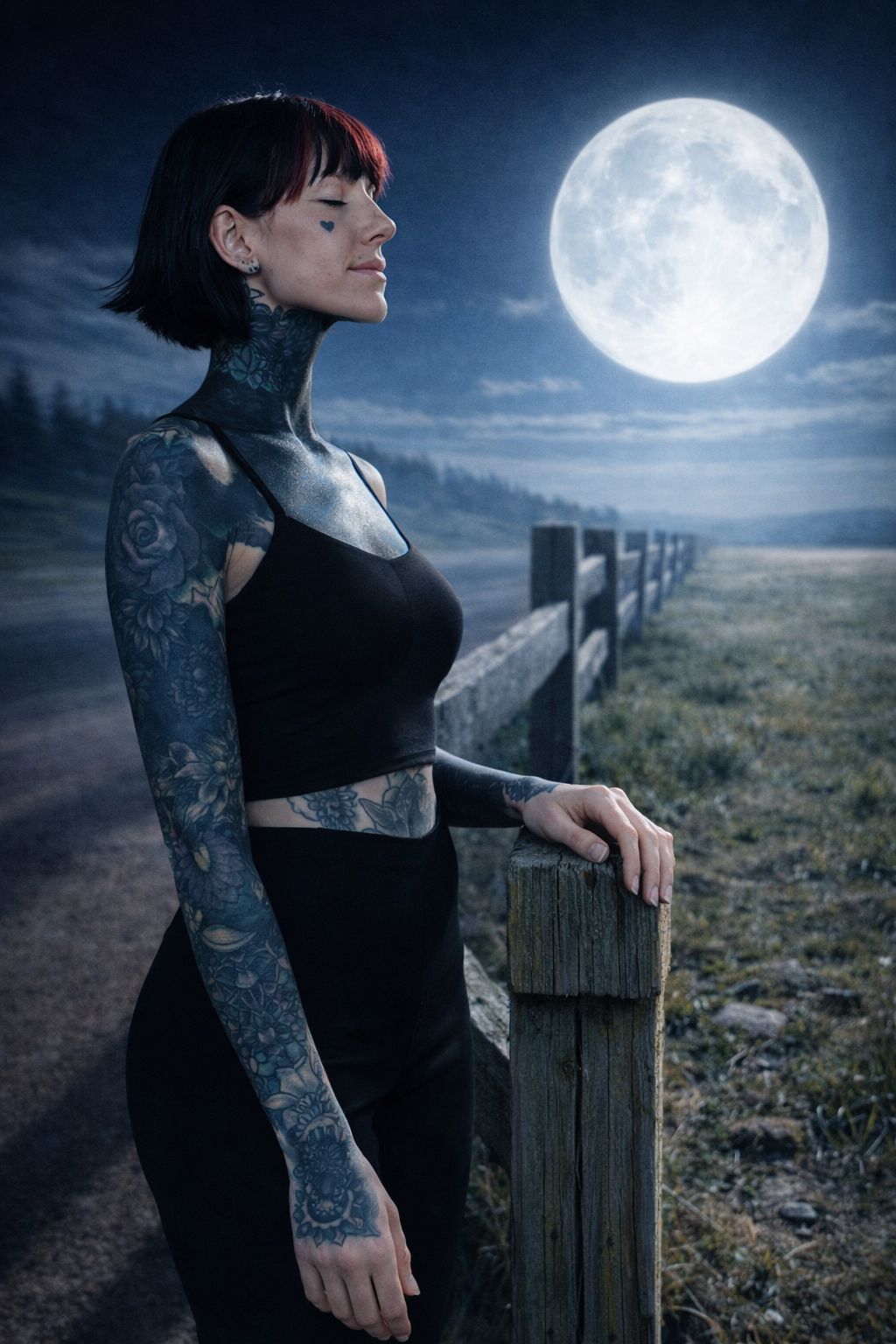
Silence teaches me —
"I was the one I kept fleeing."
The Chariot Reversed · Cancer
(Scroll below lyrics to read about the song)
[INTRO]
Rider enters the eulogy.
I am made of vigilance,
Body can't stop sprinting.
Didn't notice I was running —
until the quiet tripped my feet.
Rider is me.
[VERSE 1]
I call it "focus" when I can't feel fun.
Ghost says:
"Speed is our function"
Crow says:
"Speed is how you avoid life."
Pain is the horse saying decide.
Fear's a saddle saying:
don't slow down.
When I rest my back goes out.
…Burnout.
Triggerless trigger wired.
Rider reflex fired—
Quads grip like fear-lings.
Wear my shoulders as earrings.
Life's finally thriving—
so why am I still driving?
[PRE-CHORUS]
Ghost says, "You're mine in the dark."
I think I'm falling apart.
Crow says:
you're falling inward.
Collapse is part of the work.
[CHORUS]
Rider — running from the quiet.
Wheels keep turning.
Rider — fire keeps burning.
When I slow down, the false self goes.
Rider — I remember the road home.
Crow sees which ghosts follow.
(Rider. Rider.)
[BRIDGE]
Silence teaches me —
"I was the one I kept fleeing."
Motion is nothing without "where."
Desire is the driver.
Crow flicks a feather —
"Ride when you CHOOSE —
Not when old fear alerts you."
[PRE-CHORUS]
[CHORUS]
[OUTRO]
Crow stirs the ash:
"Eulogies aren't endings.
They're openings."
Release the road.
Rider rests her legs.
Ghost retreats…
Softer than I expect.
Exhale the rest
Card & Ghost
Tarot Card:The Chariot (Reversed)
Thoth Name:The Chariot (Unchanged)
My Ghost:Rider
Zodiac:Cancer · Planet:Moon
Cancer energy holds deep water. The Moon rules tides. The Chariot moves with will — but Rider runs from stillness.
Hebrew Letter: Cheth (ח) — fence, enclosure, boundary
Path:18
What It Means Reversed:
I'd rather crash than park. Stillness feels like a bill I forgot to pay.
About the Song
I didn't notice I was running until the quiet tripped my feet.
Life is calm now. No rats in the walls anymore. The fridge stays full. Our son sleeps in a room with walls that don't leak. Everything I used to run toward — stability, safety, a home that stays — I finally have it.
And my body still thinks it's being chased.
My thighs grip like the floor might drop. My shoulders live an inch too high, braced for an impact that never comes. I call it "focus" when I can't feel fun. I call it "discipline" when I can't rest. I scroll, clean, plan, write — anything to keep the engine humming.
Rider is the ghost of holy exhaustion. She learned young that motion meant survival. Stillness meant danger. So she built an entire personality out of velocity. Now she's safe, but her nervous system never got the memo.
This song is the sound of the engine finally idling. Not stopping — just... pausing long enough to hear what the speed was covering up.
What This Ghost Is
Rider is the version of me who mistakes panic for purpose.
She doesn't run from danger anymore. She runs from safety — because safety has no use for the version of her that only knows how to sprint.
(Case in point: I'm writing this at 4am. The house is quiet. Everyone's asleep. And instead of resting, I'm here — back already tight, fingers moving, squeezing meaning out of the silence like it owes me something. This is the Rider window. And I'm still sitting in it. Not healed. Just aware.)
Her core wound: she learned that love was earned through output. Rest was punished. Stillness meant being caught. So she became the one who never stops. The reliable one. The overfunctioner. The person who says "I've got it" until her back seizes and her heart races for no reason.
In daily life, Rider:
Wakes up at 4am to write — not from inspiration, but because the quiet feels like a deadline
Checks her phone before her own pulse
Feels guilty the moment she sits down, suddenly remembers something to go do.
Finishes a project and immediately starts another — no pause, no pride
Measures worth in tasks crossed off, not feelings felt
Exhaustion wears a name tag that says "discipline." Collapse just looks like a back spasm or flu.
Says "I'm fine" with a body that's screaming otherwise
She is terrified of what she'll meet if she slows down. The grief, the hunger, the question underneath every victory: What now?
A ghost is not the who hurt me. It's the self that flinched and stayed. A costume made from breath-holding. A decision loop dressed in praise. Rider was never the wound — she was the shape I took to keep moving when stopping felt like risk.
Where It Lives in the Body
Rider lives in my thighs.
They grip like I'm mid-sprint even when I'm sitting still. The muscle never fully relaxes — always ready to bolt, to catch up, to not fall behind. My hips carry the memory of running.
She lives in the space between my shoulder blades.
A dull ache that never clocks out. The muscles there stay braced, as if holding up a ceiling that already has its own foundation. Crow says this is the posture of someone who forgot she doesn't have to carry the sky alone.
And she lives in my back.
The week I wrote this song, my back seized. Not from lifting anything heavy — from resting. On a quiet, calm day, I bent to pick up a toy and couldn't straighten up. The spasm locked me in place. I had to crawl to the couch. That's the Rider's signature move: she collapses when she finally stops.
John Sarno taught me that back pain is often the body's distraction device. It keeps you focused on the physical so you don't have to feel the emotional. My back doesn't hurt because I lifted wrong. It hurts because I've been carrying the weight of everything I thought no one else would hold — and the moment I try to set it down, my body screams: "Who will carry it if you don't?"
It hurts because I'm angry — at the years I couldn't rest, at the chaos that trained me to brace, at the part of me that still believes stopping is failure. But I never let myself feel that rage. So my back feels it for me. It manufactures a crisis.
Louise Hay would say the lower back carries the burden of "I should have done more." Guilt dressed as posture. Fear dressed as injury. My back spasm wasn't a failure of muscle. It was a failure of permission — I never learned how to rest without the feeling that I'm wasting time or that I'm forgetting something.
So the pain is real. But the cause isn't structural. It's the ghost of over-function, the fear that if I stop producing, I'll stop mattering.
When Rider releases, my thighs soften. The space between my shoulders drops half an inch. And my lower back — it doesn't vanish the pain. It just stops screaming long enough for me to hear what it was saying: You're allowed to stop. The world won't end. Neither will you.
She lives in my heart.
My resting heart rate sits at 90-100 bpm. A low-grade alarm. A warning light that never dims. My pulse doesn't rest; it waits for the other shoe.
Tarot & Magick: The Chariot Reversed
Upright, The Chariot is willpower made visible. Direction. The ability to harness opposites — shadow and light, fear and courage — and move forward with intention. It's not about speed. It's about steering.
Reversed, the Chariot becomes compulsion. The wheels spin, but the road doesn't move. I mistake motion for progress, urgency for alignment. The ghost believes that if she stops, she'll get hurt. So she keeps driving — even when the tank is empty, even when the destination is long gone.
The Hebrew letter Cheth means fence or enclosure. Paradoxically, boundaries create traction. Without a fence, the chariot drifts. Rider has been running without rails — no edge to push against, no finish line to stop at. The cure isn't more speed. It's a wall.
Crow says: "The fence doesn't hold you back. It keeps you from flying off the curve."
Correspondences (from my study notes):
Hebrew letter: Cheth (ח) — fence, boundary, enclosure
Planet: The Moon — tides, cycles, hidden currents
Element: Water — emotion in motion
Traditional animal: The sphinx (or paired horses) — duality, control, opposing forces tamed
My chosen animal: The snail — from the Tarot of Mystical Moments deck. Most Chariot cards show a warrior racing forward, pulled by beasts of speed. But that image never fit me. I don't need to go faster. I need to carry my home with me and move at a pace my body can trust. The snail doesn't rush. It arrives. That's the lesson I'm still learning.
Why This Song Belongs Here
After Split — who learned to choose — comes Rider, who must learn to move with that choice. Not faster. Not harder. With direction.
The first ghosts (Hesitator through Gatekeeper) built walls. Split opened the door. Rider steps through — but she's been running so long she doesn't know how to walk.
She is the sister to Hesitator. Hesitator froze at the edge. Rider sprints past it, then keeps sprinting. Both are afraid of the same thing: what happens when they stop.
After Rider comes Bender, Withdrawn, Spinner — the ghosts of the body meeting truth. But first, she has to stop running from the quiet.
What This Song Is
This song does not praise the grind. It shows what the grind costs.
It asks one question: What are you outrunning?
It teaches that motion without meaning is just panic with better posture. That rest is not regression — it's reception. That the body will keep screaming until you finally turn down the volume and listen.
Crow says: "You don't have to keep checking over your shoulder. The past isn't chasing . Put your feet down. Rest."
What I Learned
I learned that I wasn't driven. I was haunted. I learned that my back pain isn't weakness — it’s the weight of promises I made to myself that I never needed to keep. I learned that stillness is not the enemy of progress. It's the ground progress grows from.
I learned that the Rider's real name is fear of arrival. And the only cure is to arrive anyway.
When Rider Shows Up
I know Rider is active when my thighs grip the couch like the floor might drop. When I feel guilty the moment I sit still. When I wake up before dawn and start working before I've taken a breath. When my back seizes after a quiet day — not from lifting, from resting.
I check for:
Where am I confusing speed with direction?
What am I outrunning instead of facing?
If I stopped right now, what am I afraid will happen?
What I've learned from others:
Steven Ray Ozanich: The body's pain is not punishment — it's punctuation. Rider's back spasms are full stops after years of run-on sentences.
Louise Hay: The back carries the weight of "I should have done more." Rest feels like failure until you learn it's not.
Crowley (via Lon Milo DuQuette): Will without wisdom is just compulsion. The Chariot teaches that direction is devotion.
Abraham-Hicks: Alignment isn't earned through exhaustion. You don't outrun resistance. You release it.
Questions I ask myself:
Where did I mistake motion for meaning today?
What would I feel if I let myself stop?
Who am I when no one needs me?
Blessing
May you stop checking the rearview for ghosts that aren't there.
May you let your shoulders remember they don't hold the sky.
May you stop measuring your worth in miles.
May you learn that stillness is not a trap — it's a room you finally get to stay in.
A little crow's on the wire, keeping watch over you. 🐦⬛
A Note from My Study
I'm still learning. I don't have this down. I'm still living in the gap, still trying to become more like the music I write. I write for myself — so I can study, so I can hear the direction I want to go.
I'm working from Aleister Crowley's Thoth Tarot, the deck that became my study guide for this album. The correspondences (Hebrew letters, paths, planets) come from that tradition. These notes are just what I've gathered. If they help someone else, that's a gift. If not, they're just breadcrumbs from my own walk.
Rider taught me that motion is not the same as progress. Now I'm learning to steer — not from fear, but from choice.
— Thank you for witnessing.
Loui Crow
